In a world driven by a constant frenetic pace, there are moments when the gaze needs to stop. A suspended instant in which time seems to loosen its grip and the body adopts another rhythm. Like a hermit withdrawing into the mountains, Miquel Ponce and Paula Valdeón open the doors to a dimension where time pauses and the gaze flows. Through an exercise of revision and contemplation, both artists clothe the space with an ornamentation so detailed that it urges us to stop, to breathe, and to observe.
Lost in a Glance emerges from this impulse to lose oneself in a moment of attention, allowing perception to activate before thought. In this sense, the works of Ponce and Valdeón act as catalysts for an experience in which perception and vital rhythm influence one another: a sustained and attentive gaze alters the viewer’s habitual cadence, opening a space where observing necessarily implies slowing down.
Lift your gaze – what can you observe? A hidden lattice, a window opening onto the sea… Move through the space, explore the details. What memories does this play of light and shadow awaken? We enter a game of attention that trains our gaze and defragments our perception – an exercise deeply conditioned by our conception of reality, which both artists propose to deconstruct. Accustomed to speed, we interpret our surroundings through urgency, losing the ability to recognize nuances, relationships, and layers of meaning that only reveal themselves when time expands.
In the works of Ponce and Valdeón, time does not appear as an abstract concept, but as something that can be traced through looking. In Paula Valdeón’s work, layers overlap and reveal the process: initial marks, wear, corrections. In Miquel Ponce’s work, material traces, sanding residues, and open finishes reveal gesture and duration. In both cases, the artwork presents itself as an inhabited surface, inviting close and detailed observation, capable of transporting us into the artist’s studio to accompany them in their creative process.
Attention becomes focused and the environment fades into the background. The space remains, but the mind shifts, as if operating from another place. It is not about understanding the work, but about accompanying it – a state in which time ceases to be measured and thought abandons its habitual urgency. The body remains, but no longer directs the experience.
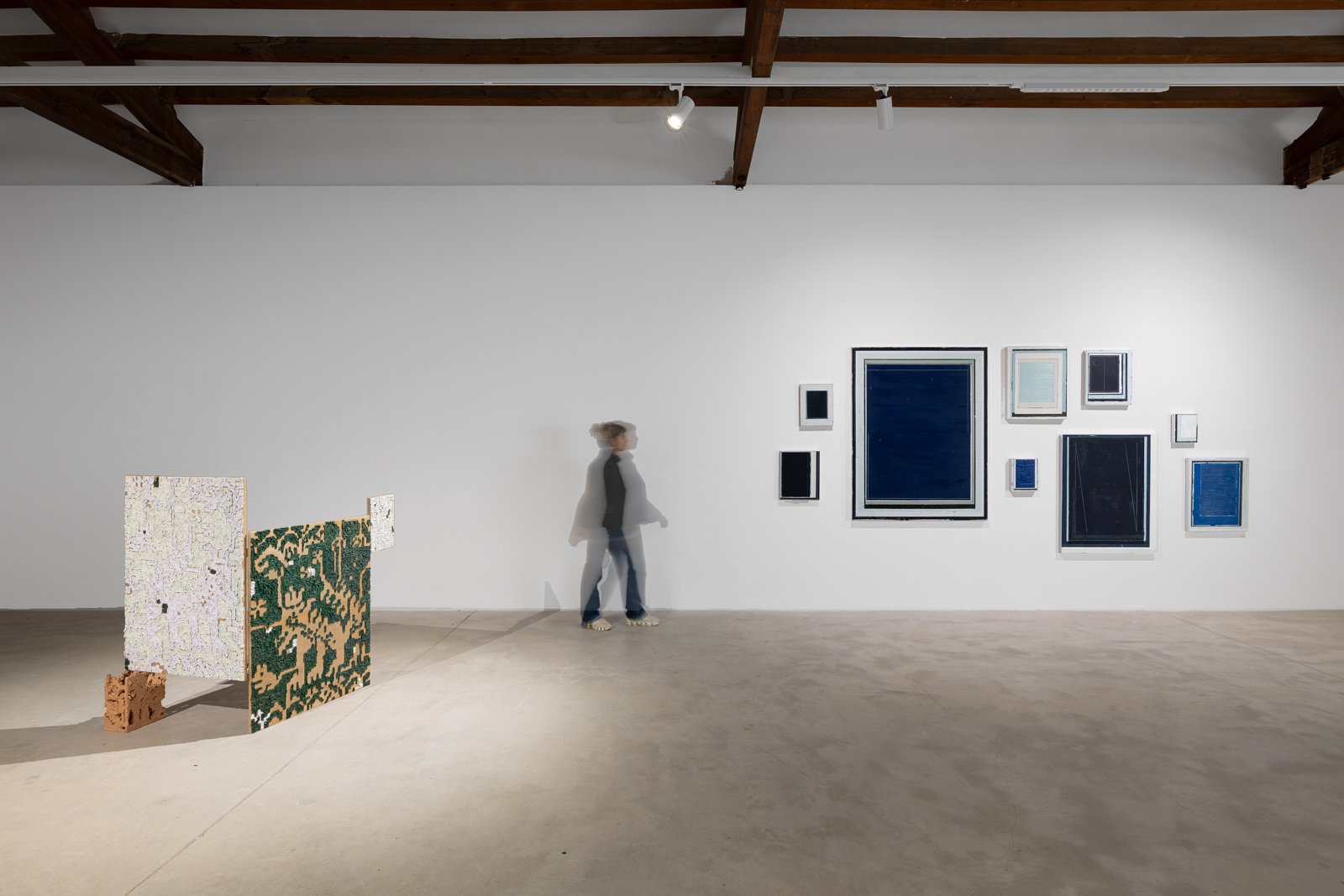
Here, art appears not only as an object of contemplation, but as a perceptual catalyst. In Miquel Ponce’s work, material residues and traces of gesture create surfaces that invite us to pause: his canvases concentrate textures, layers, and details that call for slow observation. In Paula Valdeón’s work, patterns drawn from lace curtains and handcrafted textiles, transferred onto canvas, lead us toward an equally attentive examination. Roughness, hollowed surfaces, and fragmented forms push us to uncover hidden connections and mentally reorganize elements. Natural motifs present in both practices – suggested horizons, plays of light, structures evoking organic forms – further expand this experience.
It is within this new rhythm that we sense something has changed: our perception transforms as our internal tempo shifts, revealing new forms adjusted to this altered state. At first, Valdeón’s patterns may be mistaken for urban grids – dense structures associated with constant movement, speed, and visual saturation. Yet as our rhythm slows, perception recalibrates and other readings emerge: vegetal forms, organic repetitions, connections that recall the natural ornamentation surrounding us. Something similar occurs in Ponce’s work. What initially appears as a composition of layers and geometries gradually reveals itself as a landscape reduced to its essence – an open window that transports us to another place and moment, situating us in a liminal state.
It is not the image that changes, but our way of perceiving it. The artwork thus becomes evidence of this shift: by altering our rhythm, it transforms our perception, making visible the bidirectional relationship in which looking more slowly changes what we see, and what we see confirms that something within us has paused. Fragmented and continuous, natural and constructed elements intertwine, causing each gesture and detail to concentrate our attention. As we explore them, perception sharpens and our vital cadence adjusts, revealing their close interdependence.
This attention to process and materiality also extends to the search for patterns. Through fragments, repetitions, and connections between works, the exhibition takes shape as an open experience. There is no single image or predetermined time, but multiple readings that emerge depending on how we move through and observe the space. In Paula Valdeón’s work, patterns repeat and fragment, allowing compositions to be reorganized and opened to different possible arrangements. Our gaze connects parts, completes absences, and constructs meaning from what unfolds in a non-linear way. In Miquel Ponce’s work, pieces also relate to one another through material continuity: remnants and residues from one work are integrated into the next, establishing visible continuities within a constantly transforming process.
The relationships between works, the recurrence of certain motifs, and the possibility of multiple combinations invite us to construct our own path. The artwork is not presented as a closed object, but as a system activated through sustained attention. In this process of deconstruction and recomposition, we cease to be passive observers and become active participants in the creative process. To perceive is to be involved – and through this involvement, the experience expands.
As our attention unfolds among the details, we sense how the spaces accompany and respond to us. We enter a broad area with high ceilings and shifting light, allowing the gaze to expand and breathe, embracing the whole and experiencing lightness. Its openness invites unhurried exploration, moving from one point to another, discovering connections between what is near and what stretches beyond. Leaving this openness behind and entering a smaller space adapted to our scale, attention concentrates and the body relaxes. Like leaving the nave of a cathedral to explore a chapel, we begin to notice details previously overlooked: the tactility of materials, surface textures, the subtle vibration of light upon them. Proximity sharpens the senses, inviting us to move calmly and inhabit the space more intimately and consciously.
The surrounding walls and openings allow for free movement without a fixed direction, generating a constant dialogue between space and perception. The works accompany these dimensions: some invite expansion and projection, others draw us inward toward detail, asking for closeness and patience. This oscillation reminds us that inhabiting a space is not only about moving through it, but also about feeling it – allowing it to influence our perception.
The works of Miquel Ponce and Paula Valdeón thus position themselves as proposals that challenge our habitual ways of looking. Rather than offering closed images, they present perceptual situations that require time, attention, and openness. Through process, materiality, and fragmentation, both artists generate spaces of reading where perception is reorganized, inviting the viewer to become aware of how they look, how they move, and how they inhabit time within the exhibition space.
Lost in a Glance therefore proposes an exercise in attention – an invitation to observe without urgency, to inhabit space at a different cadence, and to recognize how our way of seeing is bound to our way of living. Perhaps, by allowing ourselves to lose our rhythm for a moment, we may begin to imagine other ways of inhabiting the world.